pacman::p_load(sf, tmap, tidyverse)Hands-on Exercise 8c: Analytical Mapping
1 Overview
1.1 Objectives
For this hands-on exercise, it will allow us to gain hands-on experience on using appropriate R methods to plot analytical maps.
1.2 Learning Outcomes
By the end of this in-class exercise, you will be able to use appropriate functions of tmap and tidyverse to perform the following tasks:
- Importing geospatial data in rds format into R environment.
- Creating cartographic quality choropleth maps by using appropriate tmap functions.
- Creating rate map
- Creating percentile map
- Creating boxmap
2 Getting Started
2.1 Installing and loading packages
Before we get started, we need to ensure that tmap package of R and other related R packages have been installed and loaded into R.
2.2 Importing data
For the purpose of this hands-on exercise, a prepared data set called NGA_wp.rds will be used. This data set is a polygon feature data.frame providing information on water point of Nigeria at the local government areas (LGA) level. The data set can be found in the rds sub-direct of the hands-on data folder.
NGA_WP <- read_rds("data/rds/NGA_wp.rds")3 Basic Choropleth Mapping
3.1 Visualising distribution of functional water points
The code chunk below is used to plot a choropleth map showing the distribution of non-function water point by LGA
p1 <- tm_shape(NGA_WP) +
  tm_fill("wp_functional",
           n = 10,
           style = "equal",
           palette = "Blues") +
  tm_borders(lwd = 0.1,
             alpha = 1) +
  tm_layout(main.title = "Distribution of functional water points by LGAs",
            legend.outside = FALSE)
p2 <- tm_shape(NGA_WP) +
tm_fill("total_wp",
n = 10,
style = "equal",
palette = "Blues") +
tm_borders(lwd = 0.1,
alpha = 1) +
tm_layout(main.title = "Distribution of total water points by LGAs",
legend.outside = FALSE)tmap_arrange(p2, p1, nrow = 1)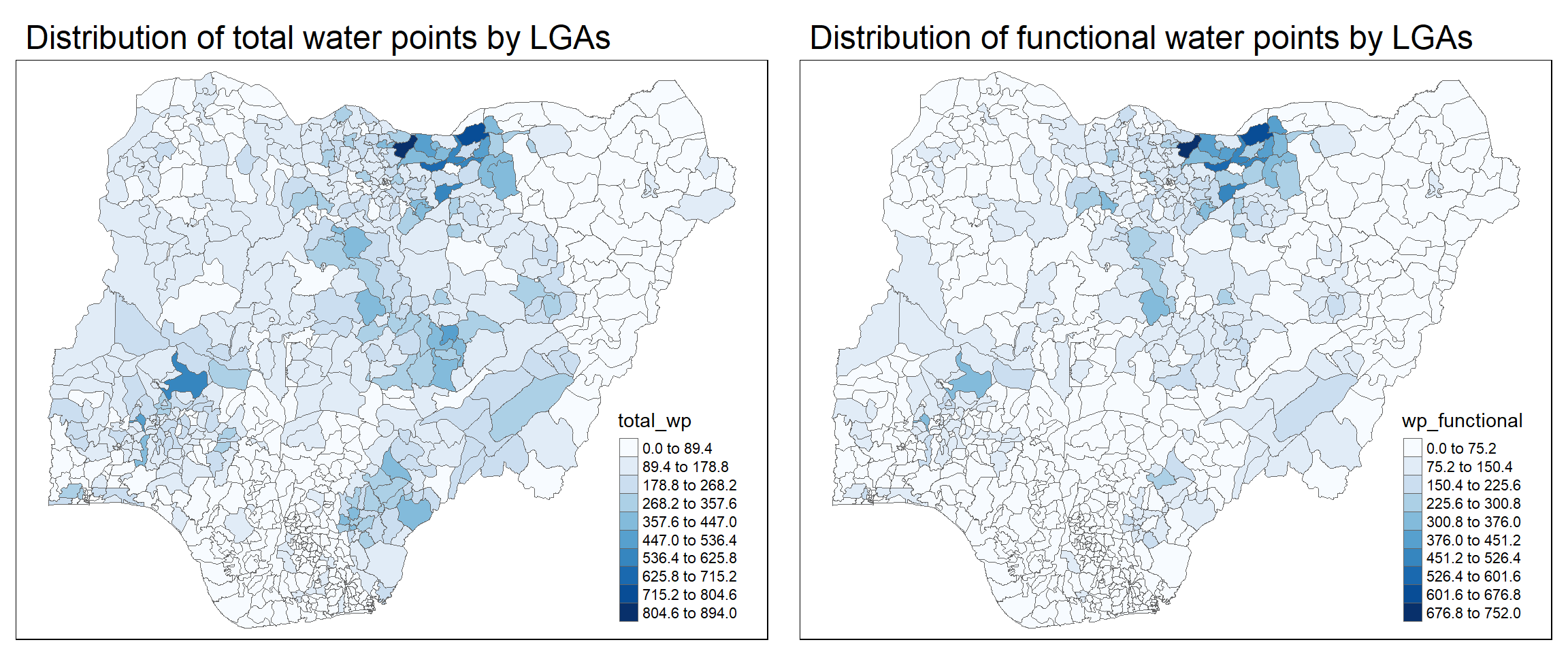
4 Choropleth Map for Rates
In much of our readings, we have now seen the importance to map rates rather than counts of things, and that is for the simple reason that water points are not equally distributed in space. That means that if we do not account for how many water points are somewhere, we end up mapping total water point size rather than our topic of interest.
4.1 Deriving Proportion of Functional Water Points and Non-Functional Water Points
We will tabulate the proportion of functional water points and the proportion of non-functional water points in each LGA. In the following code chunk, mutate() from dplyr package is used to derive two fields, namely pct_functional and pct_nonfunctional.
NGA_WP <- NGA_WP %>%
  mutate(pct_functional = wp_functional/total_wp) %>%
  mutate(pct_nonfunctional = wp_nonfunctional/total_wp)
4.2 Plotting map of rate
The code chunk below plots a choropleth map showing the distribution of percentage functional water point by LGA
tm_shape(NGA_WP) +
  tm_fill("pct_functional",
          n = 10,
          style = "equal",
          palette = "Blues",
          legend.hist = TRUE) +
  tm_borders(lwd = 0.1,
             alpha = 1) +
  tm_layout(main.title = "Rate map of functional water points by LGAs",
            legend.outside = TRUE)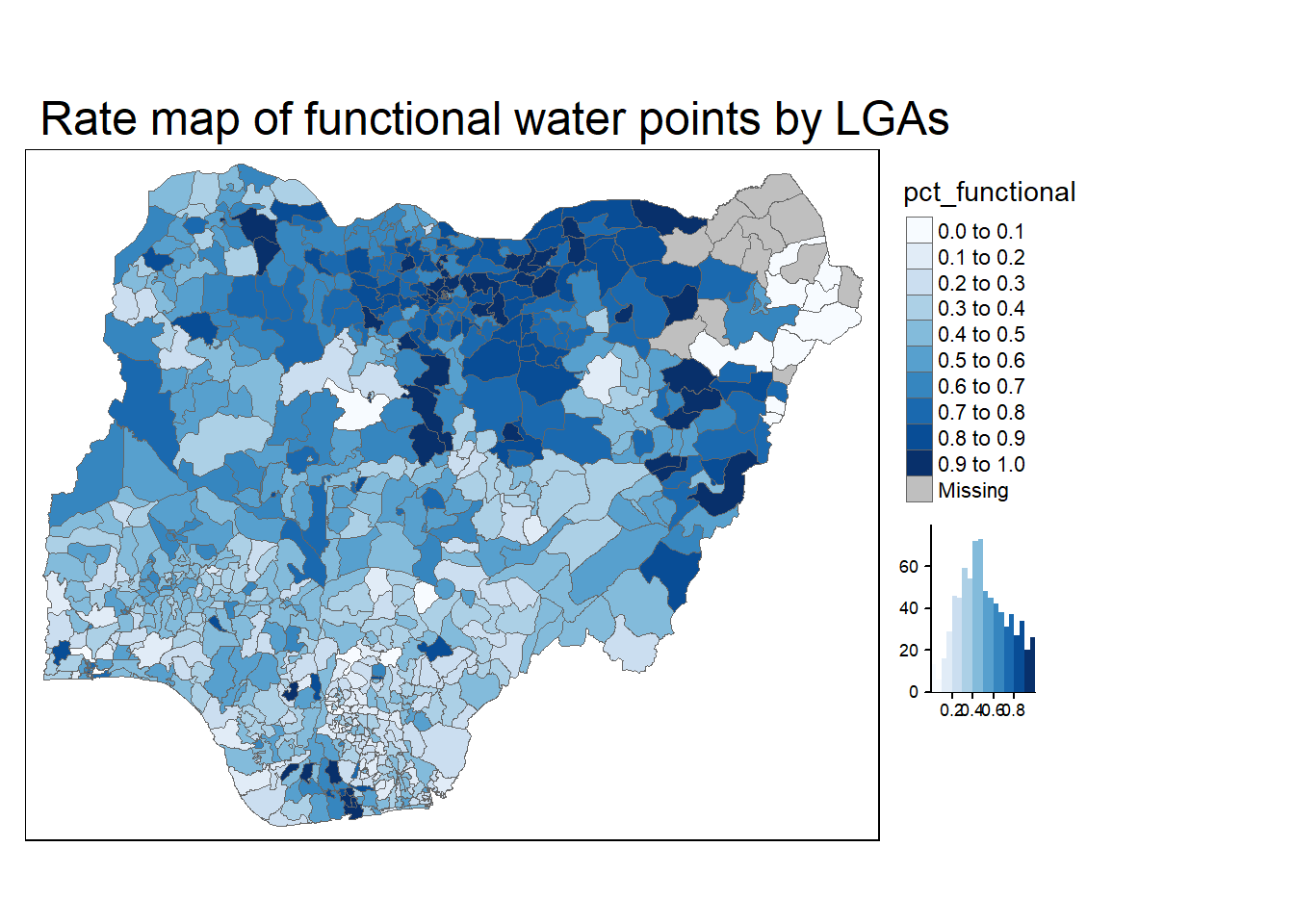
5 Extreme Value Maps
Extreme value maps are variations of common choropleth maps where the classification is designed to highlight extreme values at the lower and upper end of the scale, with the goal of identifying outliers. These maps were developed in the spirit of spatializing EDA, i.e., adding spatial features to commonly used approaches in non-spatial EDA (Anselin 1994).
5.1 Percentile Map
The percentile map is a special type of quantile map with six specific categories: 0-1%,1-10%, 10-50%,50-90%,90-99%, and 99-100%. The corresponding breakpoints can be derived by means of the base R quantile command, passing an explicit vector of cumulative probabilities as c(0,.01,.1,.5,.9,.99,1). Note that the beginning and end points need to be included.
5.1.1 Data Preparation
Step 1: Exclude records with NA by using the code chunk below.
NGA_WP <- NGA_WP %>%
  drop_na()
Step 2: Creating customised classification and extracting values
percent <- c(0,.01,.1,.5,.9,.99,1)
var <- NGA_WP["pct_functional"] %>%
  st_set_geometry(NULL)
quantile(var[,1], percent)
0% 1% 10% 50% 90% 99% 100%
0.0000000 0.0000000 0.2169811 0.4791667 0.8611111 1.0000000 1.0000000
Important
When variables are extracted from a sf data.frame, the geometry is extracted as well. For mapping and spatial manipulation, this is the expected behaviour, but many base R functions cannot deal with the geometry. Specifically, the quantile() gives an error. As a result st_set_geomtry(NULL) is used to drop geometry field.
5.1.2 Why writing functions?
Writing a function has three big advantages over using copy-and-paste:
- You can give a function an evocative name that makes your code easier to understand.
- As requirements change, you only need to update the code in one place, instead of many.
- You eliminate the chance of making incidental mistakes when you copy and paste (i.e. updating a variable name in one place, but not in another).
Source: Chapter 19: Functions of R for Data Science.
5.1.3 Creating the get.var function
Firstly, we will write an R function as shown below to extract a variable (i.e. wp_nonfunctional) as a vector out of an sf data.frame.
- arguments:
vname: variable name (as character, in quotes)
df: name of sf data frame
- returns:
- v: vector with values (without a column name)
get.var <- function(vname, df) {
  v <- df[vname] %>%
    st_set_geometry(NULL)
  v <- unname(v[,1])
  return(v)
}
5.1.4 A percentile mapping function
Next, we will write a percentile mapping function by using the code chunk below.
percentmap <- function(vnam, df, legtitle = NA, mtitle = "Percentile Map"){
  percent <- c(0,.01,.1,.5,.9,.99,1)
  var <- get.var(vnam, df)
  bperc <- quantile(var, percent)
  tm_shape(df) +
  tm_polygons() +
  tm_shape(df) +
     tm_fill(vnam,
             title = legtitle,
             breaks = bperc,
             palette = "Blues",
          labels = c("< 1%", "1% - 10%", "10% - 50%", "50% - 90%", "90% - 99%", "> 99%"))  +
  tm_borders() +
  tm_layout(main.title = mtitle,
            title.position = c("right", "bottom"))
}
5.1.5 Test drive the percentile mapping function
To run the function, type the code chunk as shown below.
percentmap("total_wp", NGA_WP)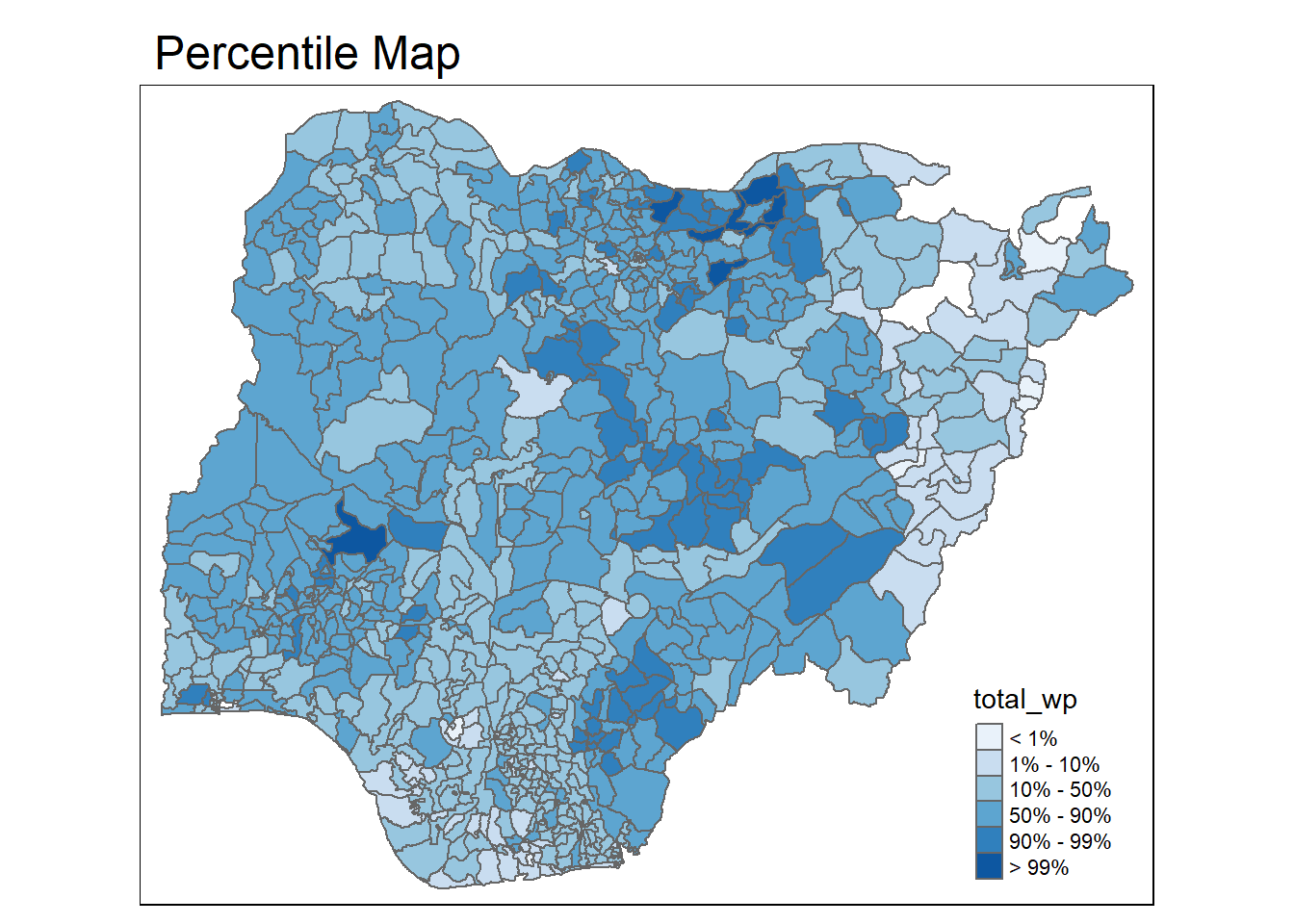
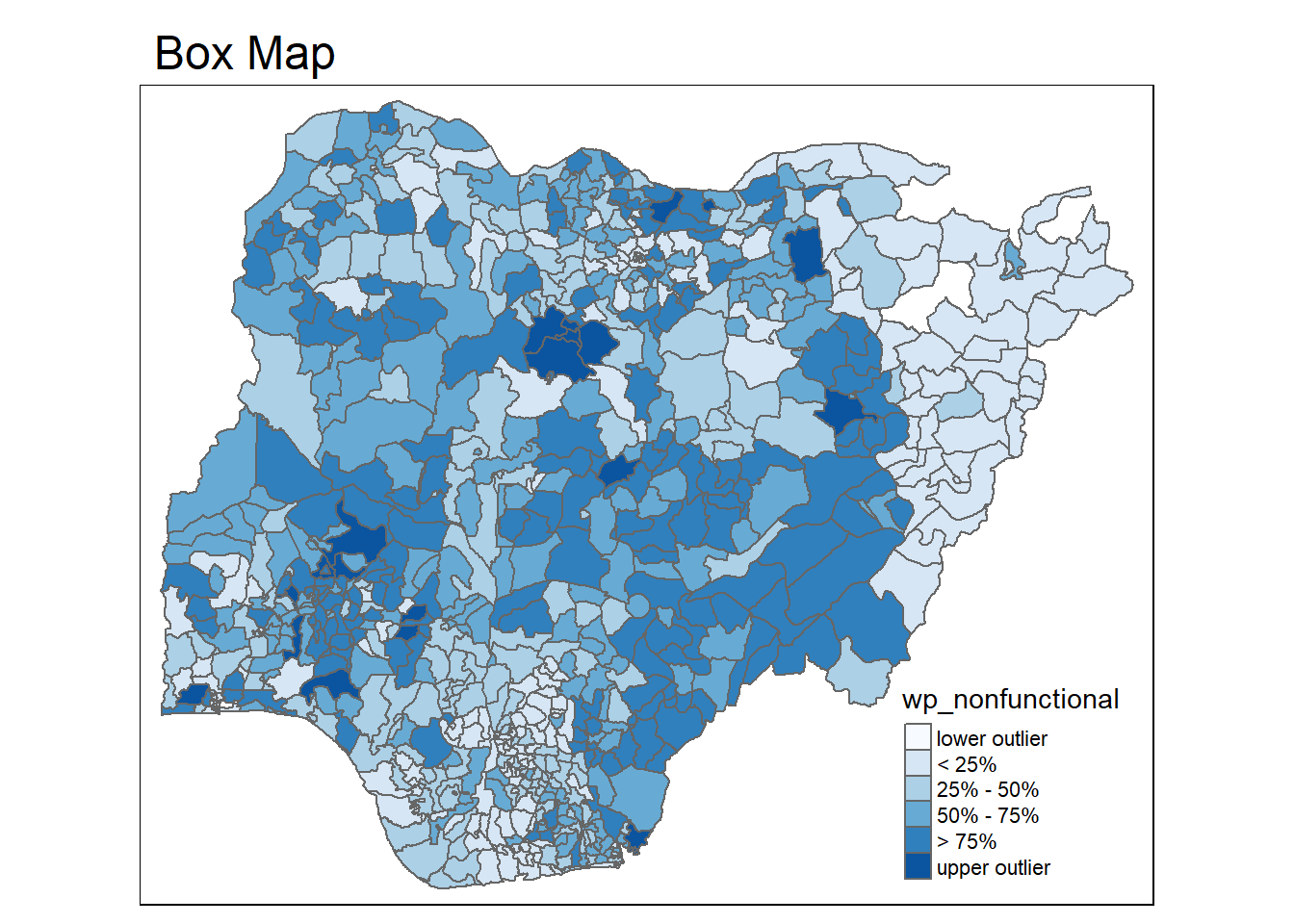
5.2 Box map
In essence, a box map is an augmented quartile map, with an additional lower and upper category. When there are lower outliers, then the starting point for the breaks is the minimum value, and the second break is the lower fence. In contrast, when there are no lower outliers, then the starting point for the breaks will be the lower fence, and the second break is the minimum value (there will be no observations that fall in the interval between the lower fence and the minimum value).
ggplot(data = NGA_WP,
       aes(x = "",
           y = wp_nonfunctional)) +
  geom_boxplot()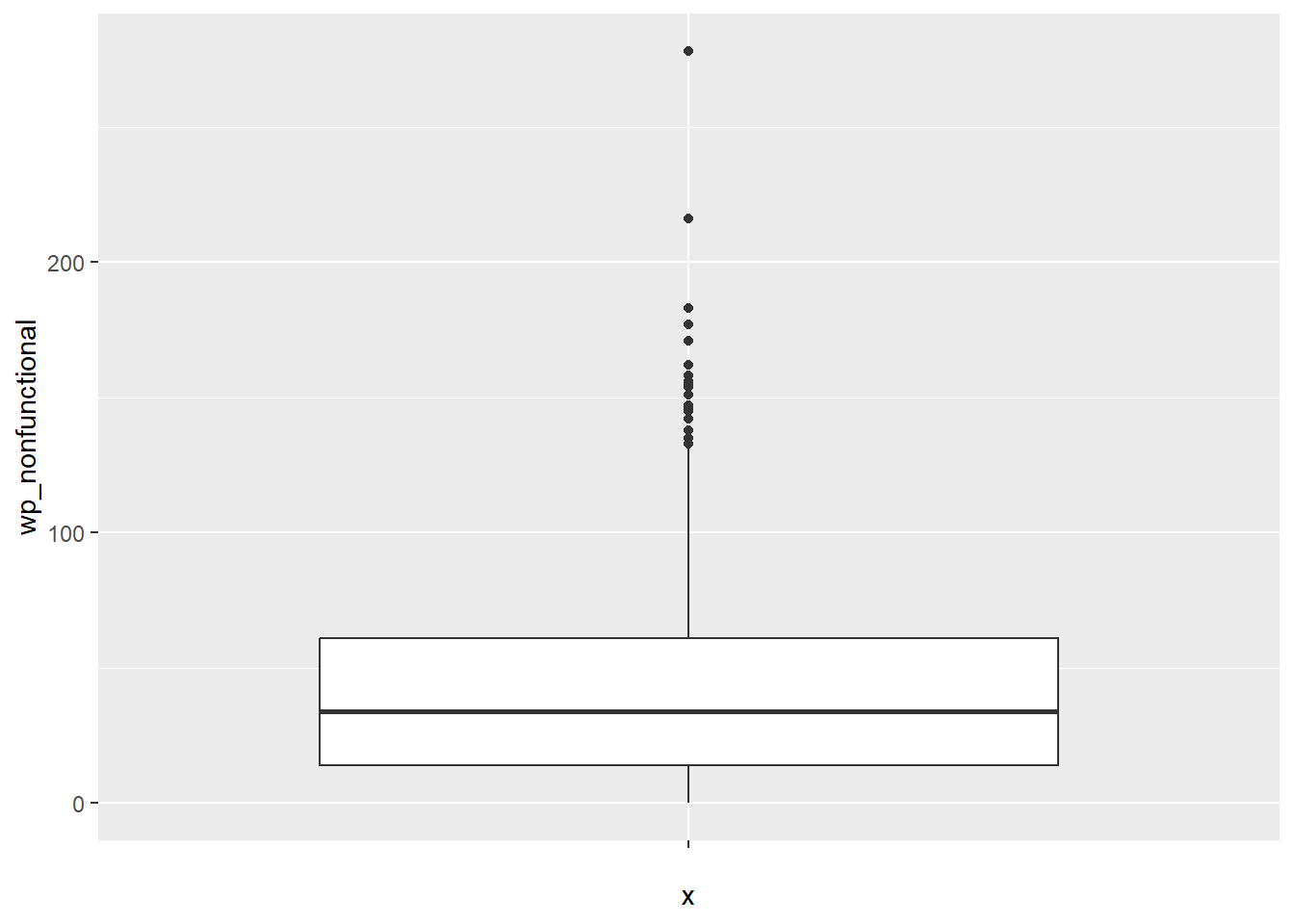
Displaying summary statistics on a choropleth map by using the basic principles of boxplot.
To create a box map, a custom breaks specification will be used. However, there is a complication. The break points for the box map vary depending on whether lower or upper outliers are present.
5.2.1 Creating the boxbreaks function
The code chunk below is an R function that creates break points for a box map.
- arguments:
v: vector with observations
mult: multiplier for IQR (default 1.5)
- returns:
- bb: vector with 7 break points compute quartile and fences
boxbreaks <- function(v, mult = 1.5) {
  qv <- unname(quantile(v))
  iqr <- qv[4] - qv[2]
  upfence <- qv[4] + mult * iqr
  lofence <- qv[2] - mult * iqr
  # initialise break points vector
  bb <- vector(mode = "numeric", length = 7)
  # logic for lower and upper fences
  if (lofence < qv[1]) {  # no lower outliers
    bb[1] <- lofence
    bb[2] <- floor(qv[1])
  } else {
    bb[2] <- lofence
    bb[1] <- qv[1]
  }
  if (upfence > qv[5]) {  # no upper outliers
    bb[7] <- upfence
    bb[6] <- ceiling(qv[5])
  } else {
    bb[6] <- upfence
    bb[7] <- qv[5]
  }
  bb[3:5] <- qv[2:4]
  return(bb)
  }
5.2.2 Creating the get.var function
The code chunk below is an R function to extract a variable as a vector out of an sf data frame.
- arguments:
vname: variable name (as character, in quotes)
df: name of sf data frame
- returns:
- v: vector with values (without a column name)
get.var <- function(vname, df) {
  v <- df[vname] %>% st_set_geometry(NULL)
  v <- unname(v[,1])
  return(v)
}
5.2.3 Test drive the newly created function
The code chunk below is used to test the newly created function
var <- get.var("wp_nonfunctional", NGA_WP)
boxbreaks(var)
[1] -56.5 0.0 14.0 34.0 61.0 131.5 278.05.2.4 Boxmap function
The code chunk below is an R function to create a box map. - arguments: - vnam: variable name (as character, in quotes) - df: simple features polygon layer - legtitle: legend title - mtitle: map title - mult: multiplier for IQR - returns: - a tmap-element (plots a map)
boxmap <- function(vnam, df,
                   legtitle = NA,
                   mtitle = "Box Map",
                   mult = 1.5){
  var <- get.var(vnam,df)
  bb <- boxbreaks(var)
  tm_shape(df) +
    tm_polygons() +
  tm_shape(df) +
    tm_fill(vnam, title = legtitle,
            breaks = bb,
            palette = "Blues",
         labels = c("lower outlier",
                    "< 25%",
                    "25% - 50%",
                    "50% - 75%",
                    "> 75%",
                    "upper outlier")) +
    tm_borders() +
    tm_layout(main.title = mtitle,
              title.position = c("left",
                                 "top"))
}tmap_mode("plot")
boxmap("wp_nonfunctional", NGA_WP)